Updates from beverlyworth Toggle Comment Threads | Keyboard Shortcuts

  • Unknown's avatar

    beverlyworth 12:06 am on July 8, 2019 Permalink | Reply  

    Exercise as a mental health intervention 

    Callaghan’s article “Exercise: A Neglected Intervention in Mental Health Care?” reviews available information regarding the intersection of exercise and mental health. Callaghan summarizes exercise’s history, reviewing the Olympic Games, mountain climbing, cultural dances, and team sports. It is found that any of these physical activities are positively linked with well-being and mental health. One mental health ailment specifically reviewed is Schizophrenia. Callaghan includes an anecdote of a patient with Schizophrenia who is able to live more independently once given information and plans focused around physical health and well-being. These plans include information about the effects of smoking, drinking, and substance abuse, and an exercise plan. Callaghan argues that “physical exercise improves well-being and mental health, reduces mental illness such as anxiety and depression”, and has a positive effect on cognitive functioning, namely in elderly populations. Although exercise has many clear benefits, it is rarely considered as a valid treatment option for mental health issues.

    From this article, I learned that different forms of physical activity are recommended for different mental health needs. For example, team sports are helpful for feelings of loneliness and isolation, and yoga and hiking are helpful for achieving feelings of connectedness and spirituality. This information is consistent with the views presented on Very Well Mind‘s website. Additionally, Callaghan presents a view that contrasts James Timmons’ lecture; exercise should be utilized as a treatment. James Timmons argues the opposite; exercise should never be prescribed as treatment.

    Callaghan’s article is relevant to my guiding questions in that it describes the effects of exercise on the body and brain. Callaghan specifically emphasizes the potential for utilizing exercise as treatment in mental health care.

    Callghan, P. (2004). Exercise: A neglected intervention in mental health care? Journal of Psychiatric and Mental Health Nursing, (11)476-483.


     
  • Unknown's avatar

    beverlyworth 12:05 am on July 8, 2019 Permalink | Reply  

    News article: Additional playtime in Elementary schools 

    Elizabeth Ucles’ news article in Community Impact Newspaper, “Elementary Students to Get Additional Playtime in the 2019-20 School Year” reports on the Frisco Independent School District’s decision to include 10-15 minutes of playtime per day to their 42 elementary schools. The district in Frisco, Texas mandated structured “brain breaks” at their schools in an effort to combat student reports of high stress and anxiety. The district first piloted these brain breaks in 5 test schools. The pilot was extremely successful. According to Ucles, “Non-test schools were twice as likely to claim feelings of being far behind in curriculum. Test schools saw no decrease in academics.” After a year of brain breaks with the 5 test schools, FISD expanded the brain breaks over all its elementary schools. These breaks give students an opportunity to be active in both body and mind, with brain break choices both indoors and outdoors.

    Ucles’ news article stated that with the implemented brain breaks, students were more capable of comprehending information, effectively holding attention, and being less disruptive. Additionally, it was reported that these brain breaks improved students’ social emotional skills as well as their immune systems.

    The FISD brain break news article helped ignite my research. Seeing that brain breaks and physical activity are so badly needed and effective in an elementary school day inspires me to present physical education as a form of stress relief and self care.

    Ucles, E. (2019, July 5). Elementary students to get additional playtime in the 2019-20 school year. Community Impact Newspaper. Retrieved from https://communityimpact.com/dallas-fort-worth/frisco/editors-pick/2019/07/05/elementary-students-to-get-additional-playtime-in-the-2019-20-school-year/

     
  • Unknown's avatar

    beverlyworth 10:19 pm on July 6, 2019 Permalink | Reply  

    The Truth About Exercise – Prof. James Timmons lecture at Loughborough University 

    Professor James Timmons discusses the reasons behind why we as humans decide to participate in physical exercise and the actual benefits behind it. Personal reasons include the social aspect, vanity, strength, positive mood, etc. Medical reasons include the prevention of chronic ailments such as high blood pressure, heart disease, and cancer, and mental health issues such as depression and anxiety.

    Timmons argues that an improved healthy lifestyle that includes physical exercise is more effective than medication for reducing the risk of developing diabetes and several other illnesses. Exercise needs to be individually tailored to the individual, as different bodies have different physical needs. Although exercise has incredible benefits, Timmons makes the argument that it can not be prescribed as a treatment for disease. This documentary directly addresses my guiding question: “How does exercise combat the effects of stress on the body?” Why Zebras Don’t Get Ulcers and HEAL have concluded that stress leads to chronic illness and disease. Professor Timmons’ lecture argues that exercise prevents these illnesses and diseases, however should not be used to treat such ailments.

    Timmons, Jamie. “The Truth about Exercise and Public Health – Professor James Timmons Dec 2012.” YouTube, YouTube, 2 Jan. 2013, http://www.youtube.com/watch?v=E42TQNWhW3w.

     
  • Unknown's avatar

    beverlyworth 8:45 am on July 6, 2019 Permalink | Reply  

    Apple Watch 

    The Apple Watch is a multi-functional piece of technology, largely marketed as a fitness tool. The watch can be customized with nearly infinite apps to aid an individual in their health and wellness journey. Apps that I use on a regular basis to aid in both my physical and mental health are:

    1. Heart Rate Monitor – a default app that comes with the watch. The wearer can check their heart rate at will or can be notified if their heart rate enters a pre-specified range. I use the heart rate monitor to evaluate my physiological reactions to stress (during scary movies, when experiencing anxiety, etc.) and to track the intensity of my workouts.
    2. Breathe – the Breathe app can be set to notify the wearer at specific times during the day or randomly. When using the Breathe app, the wearer is given a guided breathing exercise with the goal of relieving stress.
    3. Activity – Activity is a default app that comes with the watch. It monitors calories burned throughout the day, time spent standing, and minutes spent exercising (with an increased heartrate).
    4. Moodnotes – the Moodnotes app presents the wearer with a neutral smiley face with a flat line as a mouth. The wearer can then use the turning wheel on the side to change the face to become happier or more upset – essentially, find an emotion on the provided scale. The wearer then saves the chosen face and can reflect back on previously saved faces. I use this as a method to track my moods. I can compare my moods based on whether or not I exercised that day (tracked by the Activity app) and time of day.

    The Apple Watch is a very relevant artifact to my research. I can track my own personal physical and mental responses to stress and exercises, as well as reflect back on them.

    Apple. (2019, July 6). Apple Watch [Series 2, 42mm with HR Monitor, Breathe, Activity, Moodnotes].

     
  • Unknown's avatar

    beverlyworth 8:34 am on July 6, 2019 Permalink | Reply  

    Thrive & Be Whole 

    Thrive & Be Whole is a website/blog run by Ayana Labossiere Burke, a former Bay Area teacher. After experiencing teacher burnout, Labossiere Burke created this source to assist teachers and other professionals going through the same thing. She has multiple blog posts about managing a healthy work/life balance, self-care, healthy self-talk, shame, and maintaining sanity during high-stress times. Labossiere Burke promotes a “chronically healthy lifestyle” to combat stress. In regards to exercise, she argues that “physical stress is hard on your body, and that makes your body work less efficiently”.

    Labossiere Burke suggests mental methods of dealing with stress. While many of my other sources cite exercise and external self care as means of stress management, Labossiere Burke argues that an effective method to dealing with a stressor would be to change your relationship with that stressor. For example, if work is your main stressor, you may find that your perception of the stressor changes once you attempt to find a positive or spiritual connection with your job. Similar to Sapolsky, Labossiere Burke suggests social support and meaningful relationships with others as a method to approaching stress management. Thrive and Be Whole is relevant to my research as it addresses the effects of stress (specifically workplace stress) an individual’s mental health and sanity.

    Labossiere Burke, A. (2019). thriveandbewhole.com. [Blog] Thrive & Be Whole. Available at: thriveandbewhole.com

     
  • Unknown's avatar

    beverlyworth 8:31 am on July 6, 2019 Permalink | Reply  

    Very Well Mind 

    Very Well Mind has a multitude of resources regarding stress management and mental health. The site has several short articles on these subjects, including how dogs can help you manage your stress, the relationship between stress and hair loss, and misconceptions about stress.

    An specific article I found interesting on Very Well mind addresses different types of exercise and how they can be used to tackle different types of stress. Yoga helps with achieving a meditative state, karate helps with anger management, swimming is soothing, and walking can also help achieve a meditative state. Another article I found cites cardiovascular exercise, yoga, and Tai Chi as the most effective methods of tackling stress. Very Well Mind is relevant to my guiding questions as it delivers resources for stress management and how-tos for the everyday person to tackle their stressors.

    Know more. Live brighter. (2019, June 05). Retrieved from https://www.verywellmind.com/

     
  • Unknown's avatar

    beverlyworth 7:30 am on July 6, 2019 Permalink | Reply  

    yogamaris Blog 

    Maris Degener’s blog yogamaris focuses on yoga, self care, and mental health. All of her blog entries focus on searching within ones self, deep reflection, and acceptance. In regards to “fixing” mental health-related conditions such as disordered eating and drug abuse, Degener states that “if we address what’s truly going on, then the path becomes clearer. If we’re able to begin to work through and fully confront the things that manifested our disorder or dependency in the first place, like trauma or lack of control or struggles with identity, then the symptoms begin to heal in a more long-lasting and tangible way.” Degener argues that an effective method of stress management is to do the work in deconstructing the root of the problem, rather than treating symptoms superficially.

    Degener discusses self-care as an act of non-violence. Rather than the go-to thought of restraining from physical altercation, she cites healthy self-talk as a way of managing internal stress. She also discusses accepting ourselves and moving forward. If we have been a “shitty person”, acknowledge it and move forward rather than succumbing to further negative self-talk. The yogamaris blog relates to my guiding questions as it focuses on mental health and taking care of your body.

    Degener, M. (2019). yogamaris.net. [Blog] yogamaris. Available at: http://yogamaris.net

     
  • Unknown's avatar

    beverlyworth 7:26 am on July 6, 2019 Permalink | Reply  

    HEAL – documentary 

    In the Netflix documentary HEAL, it is argued that the modern human body has learned to hold on to emotions and stress. Hoarding this energy creates a “density” of energy in our bodies, leading to Western diagnoses of chronic illness. The Eastern medicinal perspective is to release this energy, rather than medicate. Greg Braden, a geologist, states that “every organ in the human body has the ability to repair heal itself, given the right environment.” He argues that this environment is proper nutrition, chemical (such as supplements), outer environment, and inner environment (mindset and stress perception). In the documentary, multiple individuals provide anecdotes regarding their chronic illness diagnoses and how they combated these illnesses with stress management and healthy lifestyle changes.

    This documentary states that 90% of doctor visits are in relation to stress-related illnesses. This seems like a very large percentage, but I believe that it could also be effected by repeat visits by individuals with chronic illness, rather than limited visits by individuals with acute ailments. Another interesting point that the documentary makes is that Western medicine was founded using a mechanistic viewpoint. In Western medicine, the body is regarded as a machine that can be given specific inputs to fix any issues. Eastern medicine argues the opposite, that the body is not a machine, but all energy. This resource specifically tackles the issue addressed in my guiding question: how does stress effect the body? This source delves deeply into chronic stress and its connection to chronic disease.

    HEAL. (2019, February 01). Retrieved July 06, 2019, from https://www.netflix.com/title/80220013

     
  • Unknown's avatar

    beverlyworth 5:17 am on July 4, 2019 Permalink | Reply  

    Interview with Maris Degener 

    I interviewed Maris Degener on July 5, 2019. Maris, currently 20, suffered from and was hospitalized with an eating disorder in high school. While recovering from her eating disorder, she began practicing yoga. In this practice, she began taking care of her body rather than continuing an unhealthy pattern of self harm and violence towards it.

    In discussing her relationship with yoga and how it has transformed since she first began practicing, she described the transformation as physical to mental. She began practicing yoga while in recovery from her eating disorder. Because part of her eating disorder was over-exercising, her doctor stated that she could try yoga because it is “only stretching”. At the time, still deep in her disorder, Maris saw practicing yoga as an opportunity to burn calories. Throughout her journey, she began rejecting a concept she had a constant struggle with: perfection. Maris cites the opposite of perfection as curiosity. In her yoga practice, she found a sense of curiosity, freedom, and joy.

    Regarding stress management, Maris stated that her tell-tale signs of stress are shoulders by her ears as well as being short with those around her. She told a story about how her mother suggested that she was due for practicing yoga because she was being short and had a mean demeanor.

    This interview was extremely helpful for my research in that Maris is living proof that the mind and body are connected. She is an avid believer in the spiritual practice of yoga. In her yoga, she practices self-reflection, self-awareness, and selfless service.

    Degener, M. (2019, July 5). Interview [interview with Beverly Worth and Jenna Faubion].

     
  • Unknown's avatar

    beverlyworth 5:12 am on July 4, 2019 Permalink | Reply  

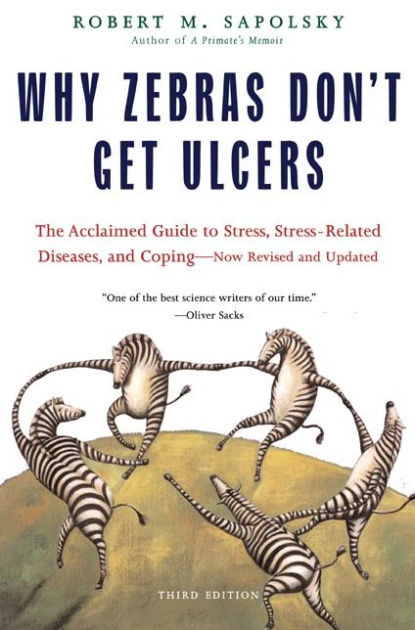
    Why Zebras Don’t Get Ulcers 

    In Robert Sapolsky’s book Why Zebras Don’t Get Ulcers, he makes a similar perspective that is presented in the Netflix documentary HEAL. Sapolsky makes the argument that the human body is built to deal with the occasional acute stressor. The example he continually cites is the scenario of running across the Savannah, away a lion (much like a zebra). Unfortunately, the “stress system” is not built to deal with constant, minor, non-life threatening stressors. Because of this, humans are constantly entering and exiting “fight or flight mode”. In fight or flight mode, the body generally shuts down so it can deal with the issue at hand. For example, the digestive system shuts down or is not able to work at full capacity while combating stress. Essentially, the body prioritizes short-term needs (stress management) rather than long-term preservation, leading to chronic stress-related diseases and issues. Sapolsky cites multiple means for stress management, including social support and exercise. He states that “exercise generally makes you feel good. . . This probably has something to do with exercise causing the secretion of beta-endorphin. In addition, there’s the sense of self-efficacy and achievement, that good stuff you try to recall when your thigh muscles are killing you in the middle of the aerobics class” (Sapolsky 204).

    An interesting fact I learned from this book was that stress increases the speed of blood flow, increasing risk for arterial and heart diseases. Increased rate of blood flow leads to inflammation, which leads to blood clots, which can lead to stroke. It was interesting to have such concrete evidence presented to back the relation of stress and chronic ailments. Another key point I took from Sapolsky’s book was that stress alters the brain in such a way to make it less able to deal with trauma. This essentially means that the presence of stress increases the intensity of future perceived stress. Why Zebras Don’t Get Ulcers addresses both my guiding questions. Sapolsky provides a multitude of stress manifestations in the human body including disease, mental illness, and the specific changes in the body and brain that lead to these circumstances. This resource also cites physical exercise as a major contender as a form of stress management.

    Sapolsky, R. M. (2004). Why zebras don’t get ulcers. St. Martin’s Griffin.

     
c
Compose new post
j
Next post/Next comment
k
Previous post/Previous comment
r
Reply
e
Edit
o
Show/Hide comments
t
Go to top
l
Go to login
h
Show/Hide help
shift + esc
Cancel
Design a site like this with WordPress.com
Get started