
Why Zebras Don’t Get Ulcers
In Robert Sapolsky’s book Why Zebras Don’t Get Ulcers, he makes a similar perspective that is presented in the Netflix documentary HEAL. Sapolsky makes the argument that the human body is built to deal with the occasional acute stressor. The example he continually cites is the scenario of running across the Savannah, away a lion (much like a zebra). Unfortunately, the “stress system” is not built to deal with constant, minor, non-life threatening stressors. Because of this, humans are constantly entering and exiting “fight or flight mode”. In fight or flight mode, the body generally shuts down so it can deal with the issue at hand. For example, the digestive system shuts down or is not able to work at full capacity while combating stress. Essentially, the body prioritizes short-term needs (stress management) rather than long-term preservation, leading to chronic stress-related diseases and issues. Sapolsky cites multiple means for stress management, including social support and exercise. He states that “exercise generally makes you feel good. . . This probably has something to do with exercise causing the secretion of beta-endorphin. In addition, there’s the sense of self-efficacy and achievement, that good stuff you try to recall when your thigh muscles are killing you in the middle of the aerobics class” (Sapolsky 204).
An interesting fact I learned from this book was that stress increases the speed of blood flow, increasing risk for arterial and heart diseases. Increased rate of blood flow leads to inflammation, which leads to blood clots, which can lead to stroke. It was interesting to have such concrete evidence presented to back the relation of stress and chronic ailments. Another key point I took from Sapolsky’s book was that stress alters the brain in such a way to make it less able to deal with trauma. This essentially means that the presence of stress increases the intensity of future perceived stress. Why Zebras Don’t Get Ulcers addresses both my guiding questions. Sapolsky provides a multitude of stress manifestations in the human body including disease, mental illness, and the specific changes in the body and brain that lead to these circumstances. This resource also cites physical exercise as a major contender as a form of stress management.
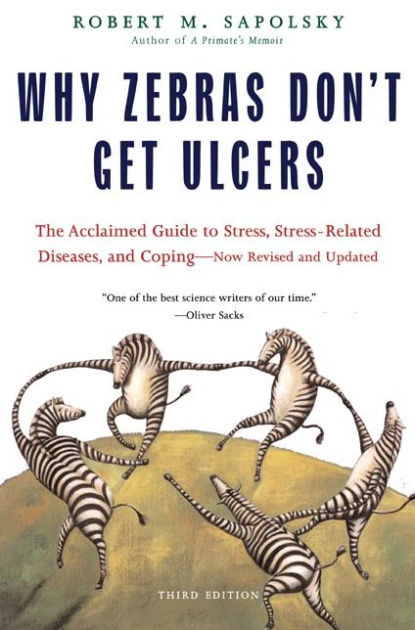
Sapolsky, R. M. (2004). Why zebras don’t get ulcers. St. Martin’s Griffin.
 Miss Worth
Reply